
Sober Curious
Nudging Toward Third Places
People don't want less connection, they want an alternative to the bar.
We built the nudge that gets them there.
Scroll Down ⬇
Behavioral Science Research Journey Mapping Generative Research












PROJECT METADATA
The Basics
ROLE
UX Designer
UX Researcher
MEMBERS
Suleyman Sarigoz (me)
Abner Benjamin
Anu Khatri
Apurda Mohapatra
Vedant Darak
INDUSTRY
Behavioral Health / Digital Health & Wellness
TIMELINE
2.5 Months
TOOLS
Figma
ChatGPT
Google Scholar
NotebookLM
PROJECT SUMMARY ★
The TL;DR
THE PROBLEM
The Gap Nobody Fills
People who want to drink less often stay in alcohol-centered spaces because no easy alternative gets suggested when it matters.
SOLUTION & METHOD
A Nudge, Grounded in Research
We designed an SMS nudge service that surfaces alcohol-optional "third places" at key decision moments, grounded in behavioral science research and 10 user interviews.
OUTCOME
From Typing to Tapping
Early testing showed a typed-response interaction created friction, so we simplified it to tap-to-select.
INTERACTIVE PROTOTYPE
Try Sober Curious
PROJECT CONTRAINTS ◼︎
Working Within Real Limits
SCOPE & TIMELINE
A Small Team, A Tight Clock
A 2.5-month timeline and a 5-person team meant we had to choose where to focus our effort.
PRIORITIZATION & OUTCOME
Research First, Design Second
We deliberately prioritized behavioral research over design execution, resulting in a research-validated concept rather than a fully designed, tested product.
PROBLEM & SOLUTION ✖︎❤︎
The Bar Isn't the Point
THE PROBLEM
The Third Place Problem
Alcohol is culturally tied to socializing and relaxation, but overconsumption leads to negative outcomes leading to feeling regret the next day.
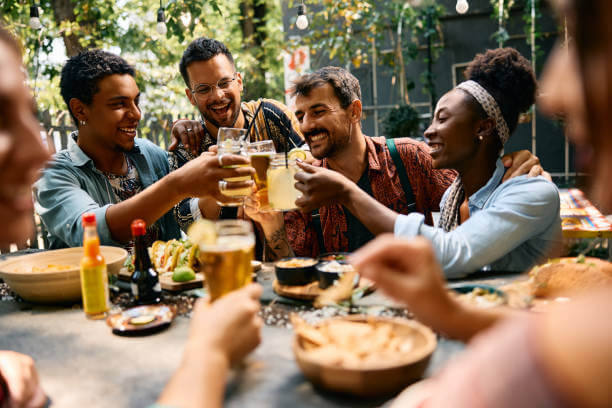
For people trying to drink less, the hardest part usually isn't the alcohol, it's the fear of losing their social life along with it. Our research found that people default to bars and parties not because they love drinking, but because nothing else gets suggested at the moment it matters. This project asked a simple question: what happens if you make the alternative just as easy to reach for?
Social Norms Misperception
People overestimate how much peers drink, which influences their own consumption patterns.
Stress Driven Behavior
Higher stress correlates with increased drinking, especially when alcohol is used as a coping mechanism.
THE SOLUTION
A Nudge, Not a New Habit
Our solution is a messaging service that sends timely suggestions for "third places," social spaces where alcohol is optional or secondary, right when people are deciding where to go. We considered a dedicated app but chose messaging as the leaner, more direct way to attack the core problem without overbuilding.
Desirability
People default to alcohol-centered events to socialize, but our research showed they're not attached to alcohol itself; they just don't have alternatives surfaced when it matters.
Feasibility
A text-based subscription service keeps the barrier to entry low: no app download, no special hardware, works on any basic phone plan.
Viability
The Nudge, an existing local-recommendation service, already proves this model at scale (10 cities, 1M+ users). We're applying that same mechanism to a more specific niche: alcohol-optional alternatives.
THE RESEARCH ◉
What We Learned
Literature Review
Our reading takeaways capture key insights into why people struggle to cut back on alcohol.
*Each team member conducted research on a certain topic with 2-3 supporting peer reviewed literature review articles.
Reading Takeaways
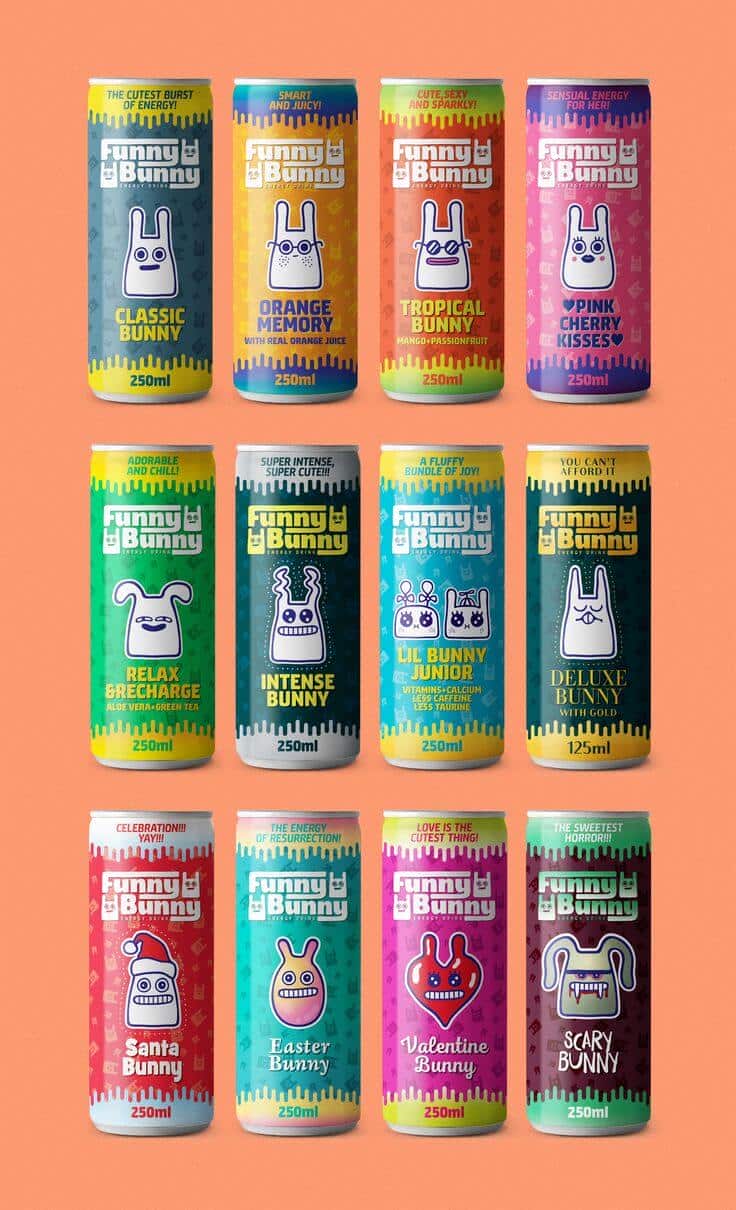
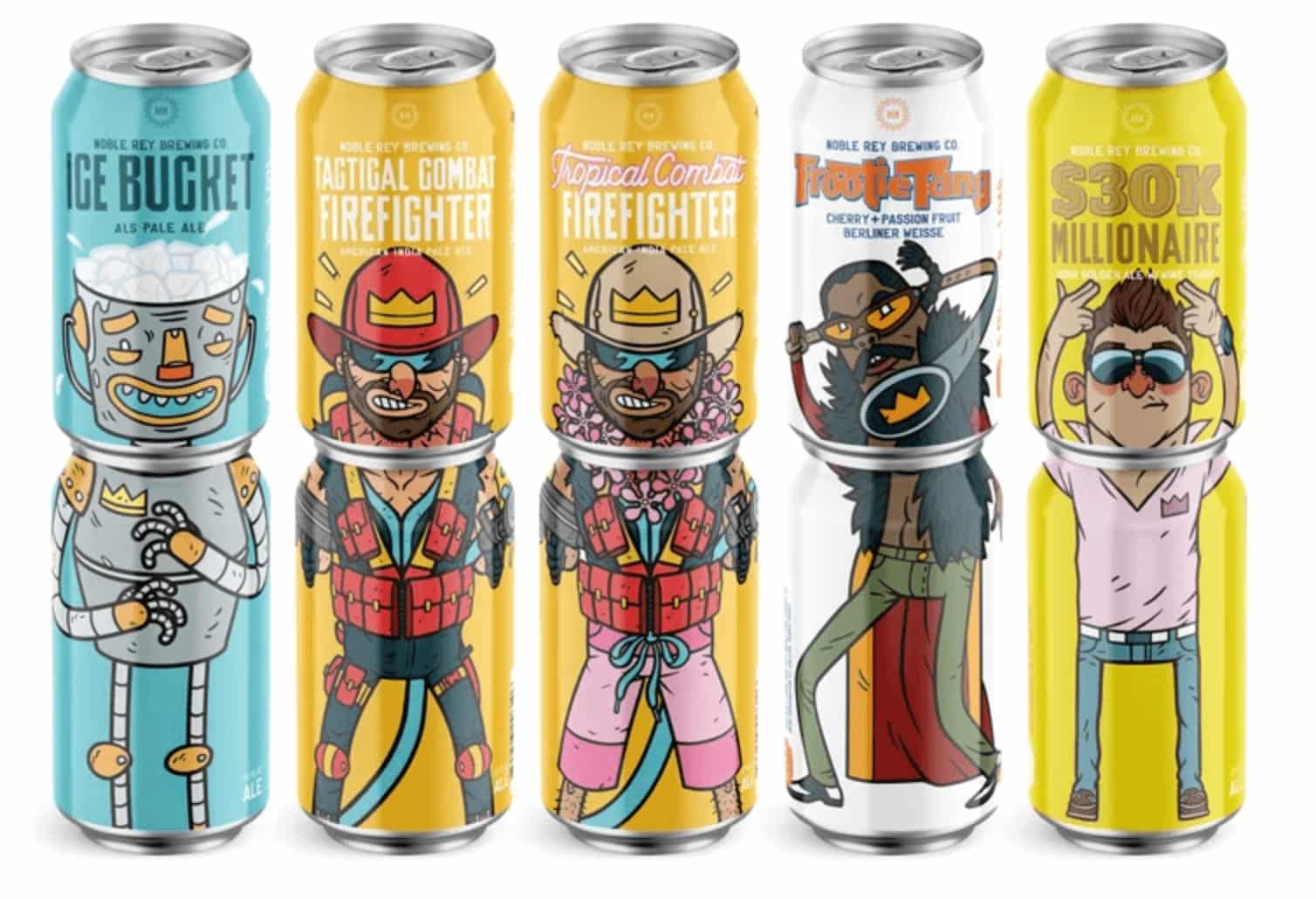
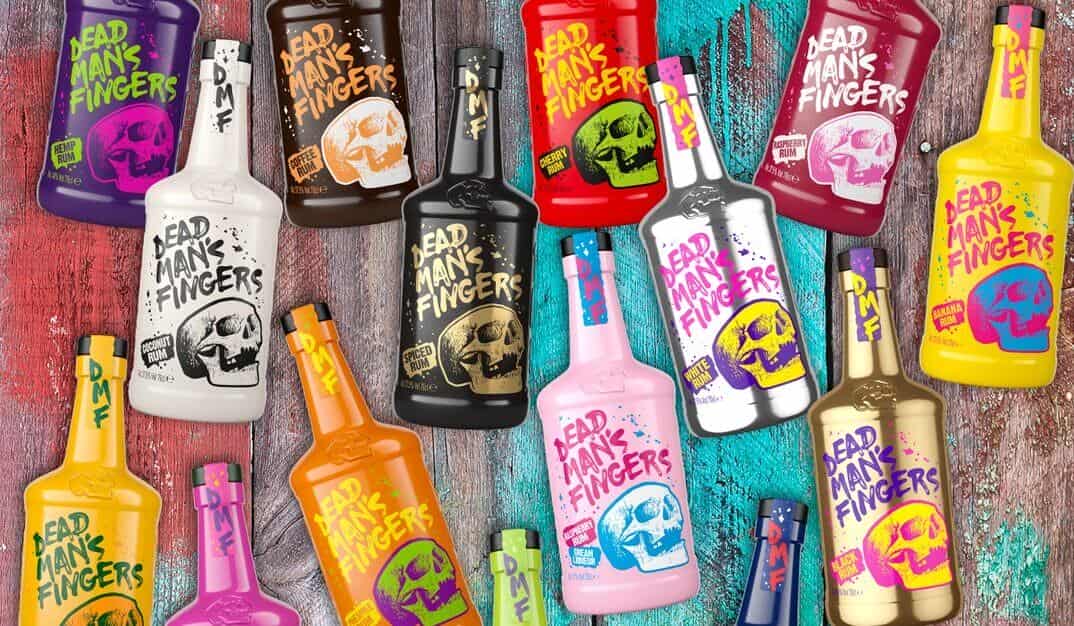
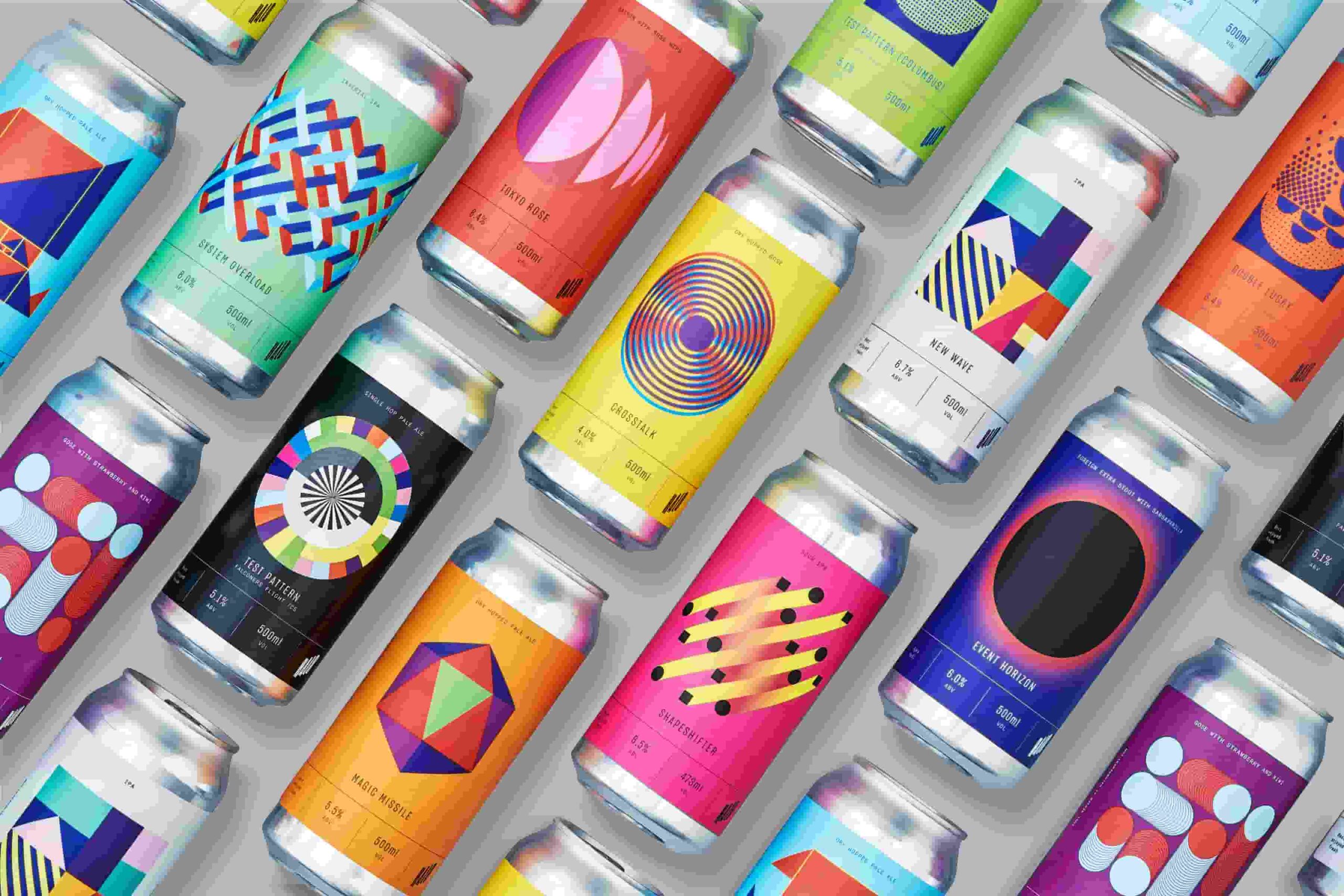
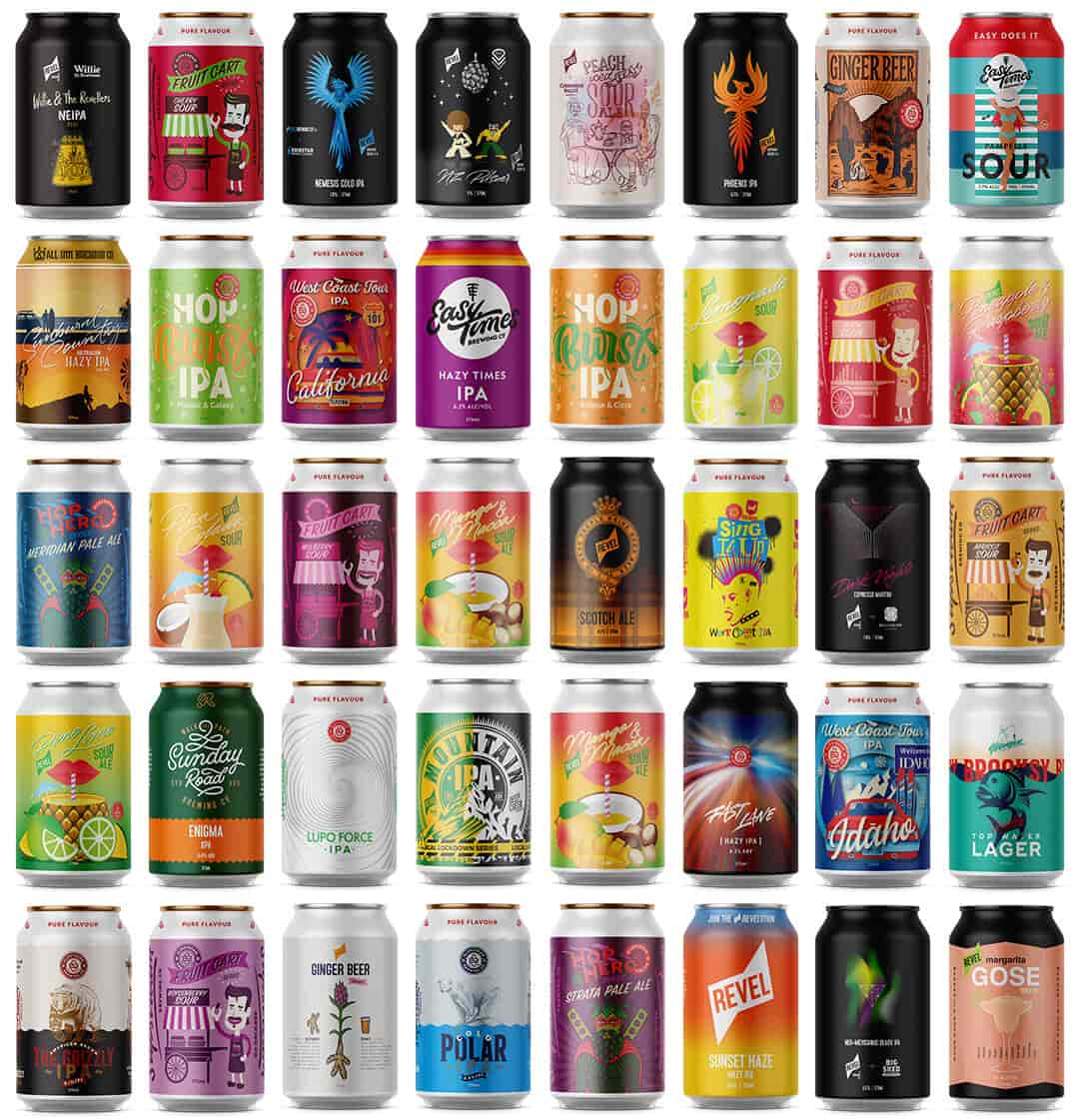
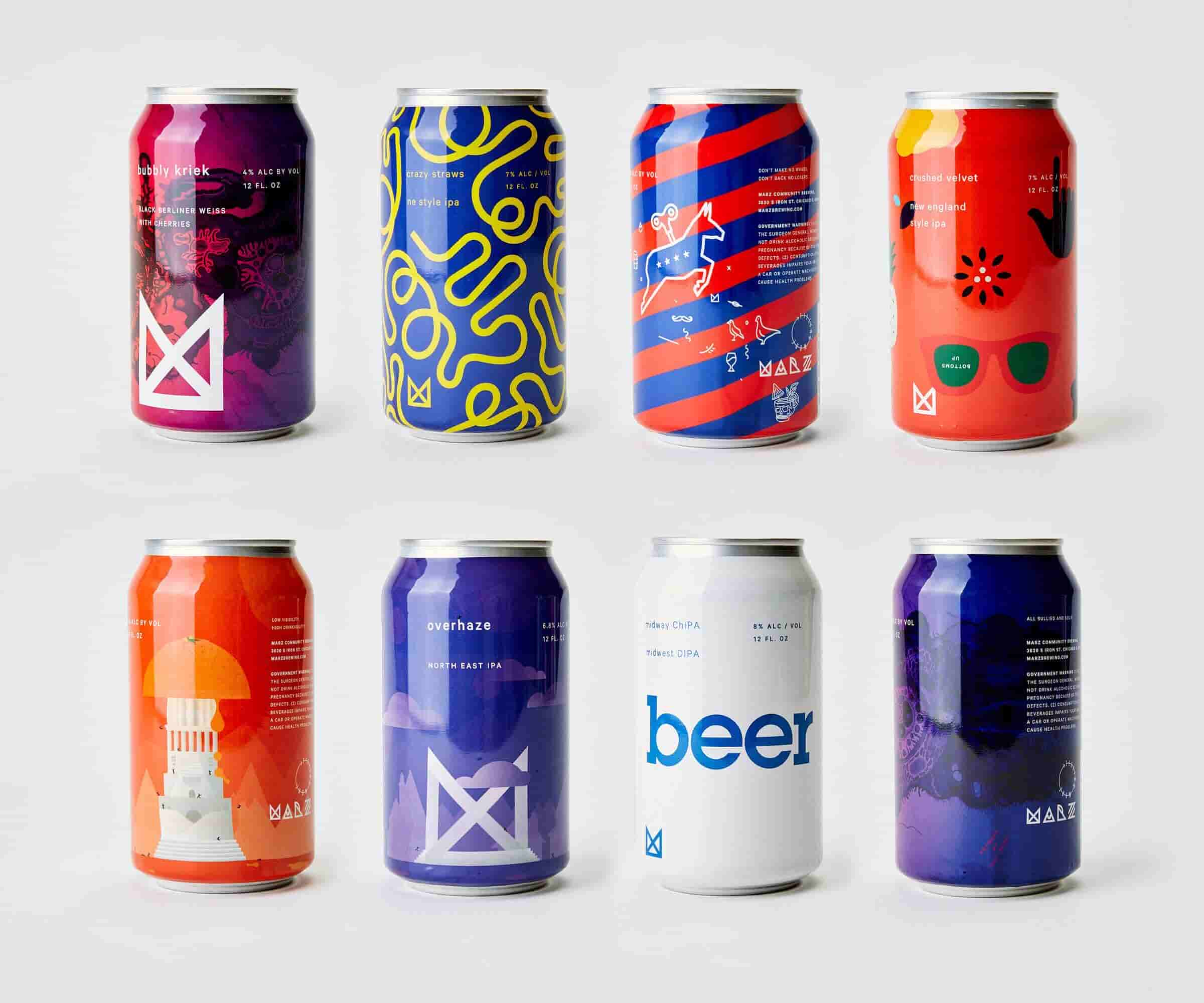
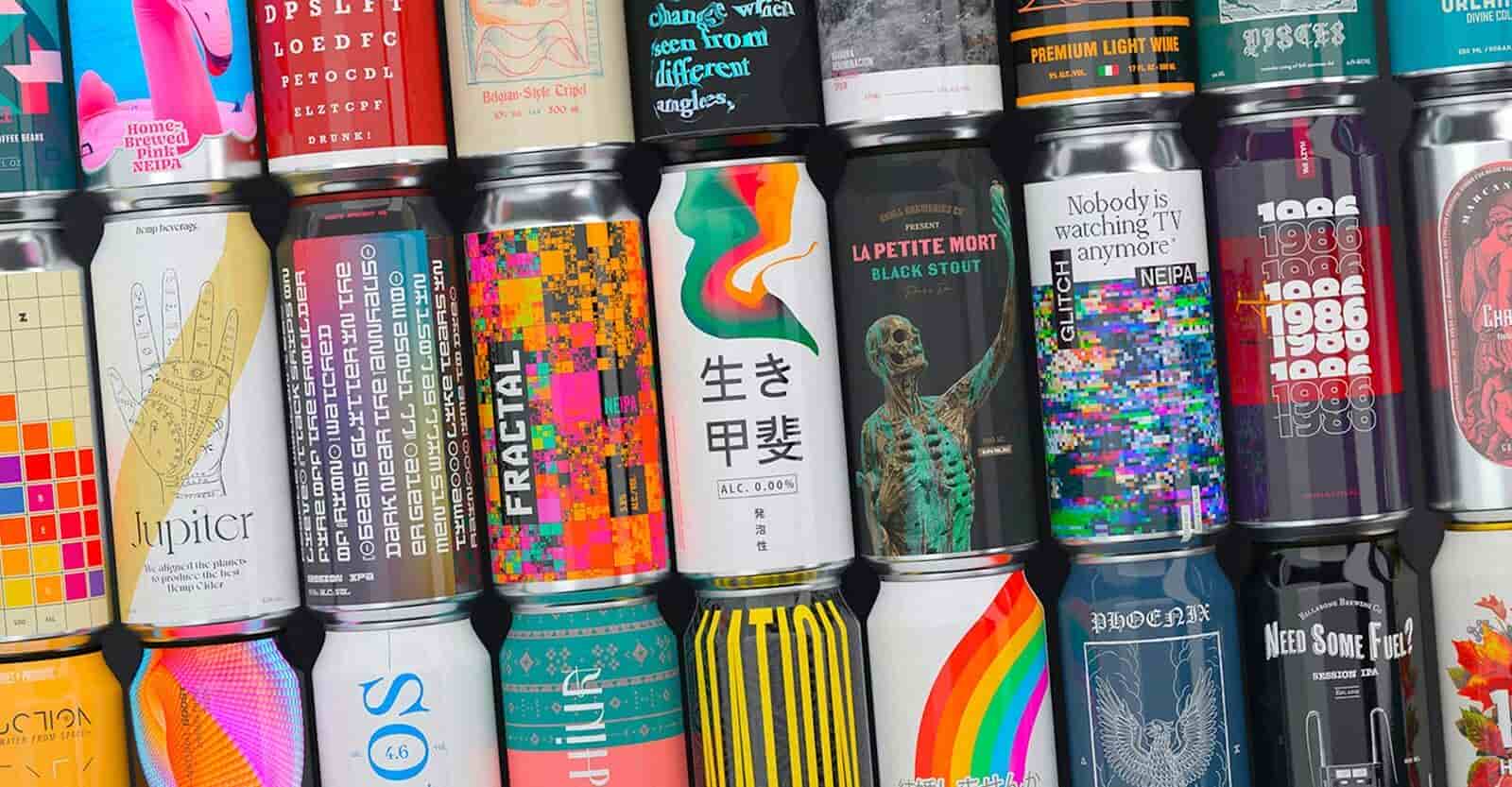
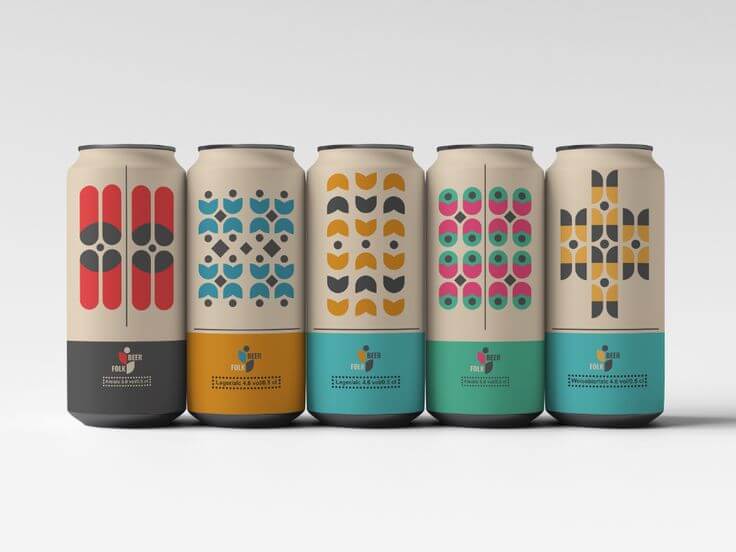
Marketing & Visibility Of Alcohol
● Why: We looked at how packaging and branding shape drinking decisions before a person even considers the alcohol itself.
● Observation: Occasion-based branding clearly works on consumers; worth exploring whether our own nudges could borrow that same occasion-linked recognition in a future iteration.
- Alcohol packaging is nearly unavoidable. Participants encountered it constantly across stores, bars, social media, and everyday browsing, which normalizes it as background scenery rather than a marketed product (Jones et al., 2021).
- Package aesthetics directly drive purchases: several participants admitted to buying a drink they didn't even like the taste of, purely because of how the packaging looked (Jones et al., 2021).
- Brands are mentally filed by occasion, not just flavor. Certain labels are associated with sports-watching, festivals, travel, or "getting drunk," which shapes what people reach for based on the moment, not the drink itself (Jones et al., 2021).
- Limited editions, unique shapes, and "eco-friendly" packaging cues (like recycled glass or plastic-free ring packs) increase perceived value, and some empty bottles even get kept as collectibles (Jones et al., 2021).
- On the deterrent side, large-text and pictorial health warnings were far more effective than small text at reducing a product's appeal and making people pause before buying. Pictorial warnings were about ten times more effective at prompting hesitation (Jones et al., 2022).
- Most people say they rarely notice or read health labels on alcohol at all, and there's strong demand (94.7%) for alcohol unit content to be clearly stated on packaging (Jones et al., 2022).
Gender & Its Effect on Health from Alcohol Consumption
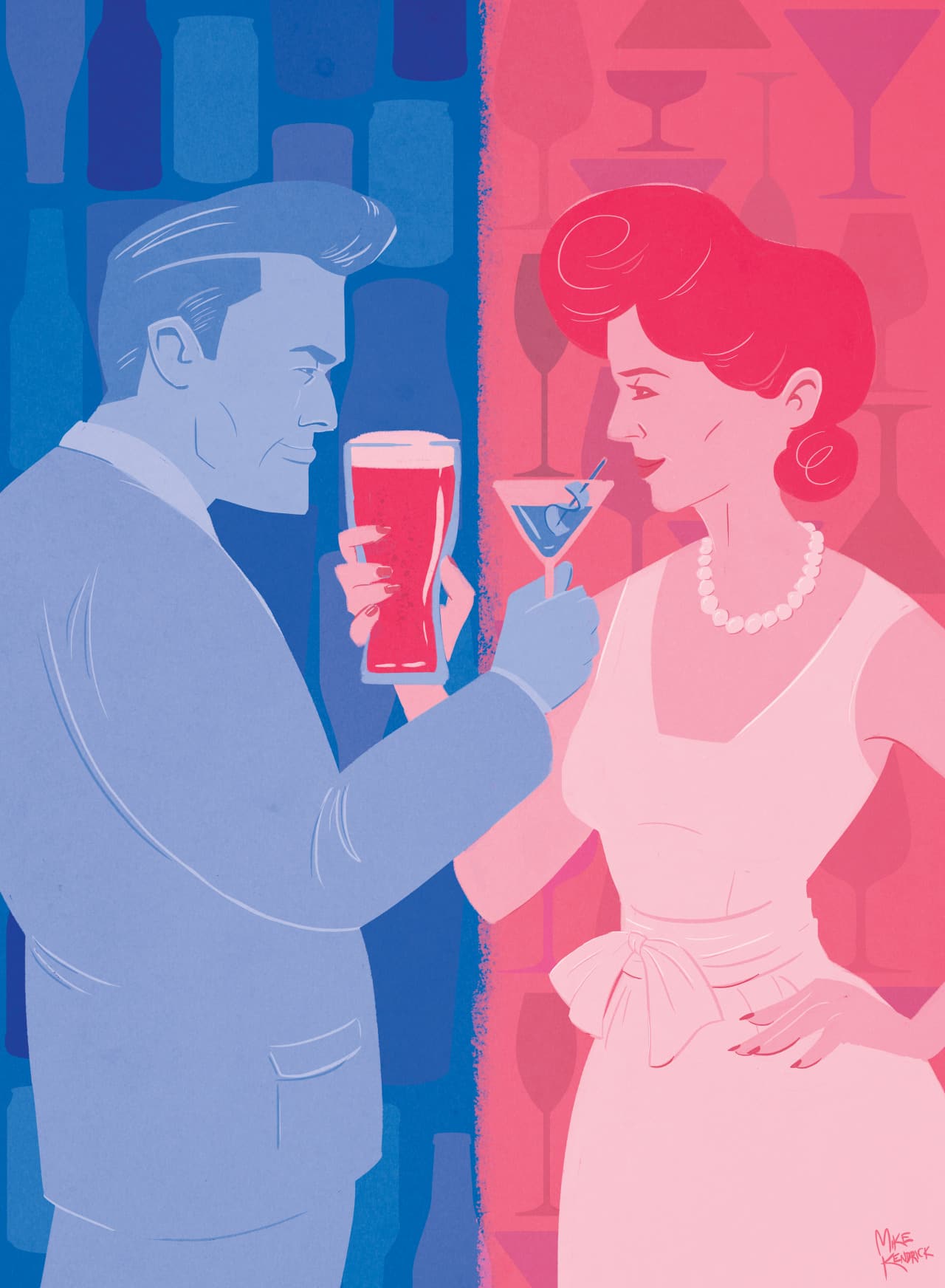
Consumption habits are dictated by gender performance, where drinking acts as a tool for masculine risk-taking or a requirement for professional belonging.
● Why: We wanted to know if drinking motivations differ enough by gender to affect how our nudges should be written.
● Observation: Messaging likely can't be gender-neutral by default; message tone across gendered experiences would need dedicated testing.
- Men drink more often and at higher levels than women, and have a higher likelihood of developing dependence, though biological factors like body composition play a role alongside social ones (Holmila & Raitasalo, 2005).
- Masculinity is culturally linked to binge drinking and "keeping up," which overlaps with other traditionally masculine traits like risk-taking and competition (Uy et al., 2014).
- Because traditional masculine norms discourage openly expressing emotion, alcohol becomes a more common coping outlet for men than it is for women (Uy et al., 2014).
- Women report more caution around drinking, driven by health and appearance concerns, and by heightened awareness of the risk of physical or sexual assault while intoxicated (Holmila & Raitasalo, 2005).
- A clear double standard exists: public intoxication is more socially accepted for men, while the same behavior is judged as unladylike for women (De Visser & McDonnell, 2012).
- Alcohol type carries gendered meaning too. Beer and liquor are coded masculine, wine and mixed drinks are coded feminine, a divide reinforced over time by marketing and media (Holmila & Raitasalo, 2005).
- Many women acknowledge they don't personally agree with these norms, yet still choose "feminine" drinks like wine to be perceived as more attractive or appropriately gendered (De Visser & McDonnell, 2012).
- Notably, women working in male-dominated fields report drinking more, seemingly to match perceived expectations and be taken seriously in that environment (Holmila & Raitasalo, 2005).
Psychological Factors – Stress, Anxiety, Mental Health
People drink for two distinct psychological reasons — to cope with negative emotions like stress and anxiety, or to enhance positive social experiences — and coping-driven drinking carries far greater risk of developing into a real problem.
● Why: We wanted to separate people who drink to cope from people who drink to enhance a social moment.
● Impact: This research led to us focusing on enhancement motives rather than coping-motivated due to the depth of adressing it.
- Drinking motives split into two types: coping (managing stress/anxiety) and enhancement (chasing social euphoria) — and they predict very different outcomes (Cooper et al., 1995).
- Coping-motivated drinking directly predicts drinking problems; enhancement-motivated drinking only leads to problems indirectly, through higher overall use (Cooper et al., 1995).
- People under high stress with weak coping skills drink significantly more than their peers (Cooper et al., 1995).
- Stress is the leading trigger for relapse after someone tries to cut back (D'Aquino & Callinan, 2024).
- Stress overrides intentional limits ("I'll just have one") and pushes people toward impulsive, not planned, consumption. Men more often rely on alcohol to cope with stress over the long term; women report more coping-driven drinking during acute, short-term stress (D'Aquino & Callinan, 2024).

Social Influences
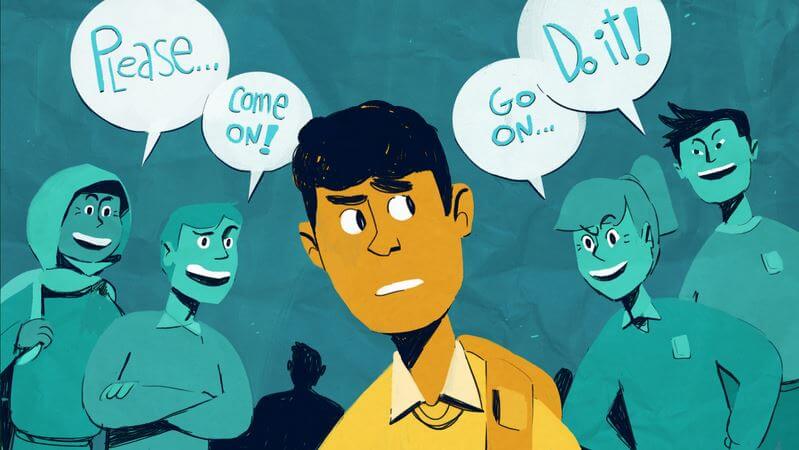
Peer-driven social pressure and the misperception of "normal" drinking levels are the primary drivers of excessive consumption and social isolation.
● Why: We reviewed peer-influence research to see if social pressure was a perception problem or an actual behavior gap.
● Impact: Since the gap is mostly perceptual, a nudge that simply surfaces an alternative can work without changing beliefs.
- Parental attitudes and even authority figures like Resident Advisers have only a modest effect on college drinking decisions. Peers matter far more, simply because students spend the most unsupervised time with them (Perkins).
- Students consistently overestimate how much their peers drink, and that misperception alone pushes their own consumption upward to match a norm that doesn't actually exist (Perkins).
- Peer pressure isn't one thing: drinkers tend to experience it as "friendly," a light nudge rather than real pressure, while non-drinkers are more likely to experience it as forced, since they're treated as the outlier in the group (Morris et al.).
- To avoid that pressure, non-drinkers often make excuses, seek out other non-drinking friends, or skip social events entirely, all of which risk isolating them further (Morris et al.).
- Across a wide age range (18 to 52), this pattern holds: alcohol remains so tied to socializing in certain settings that even people who don't want to drink feel pressure to conform (Morris et al.).


Personal Beliefs on Consumption
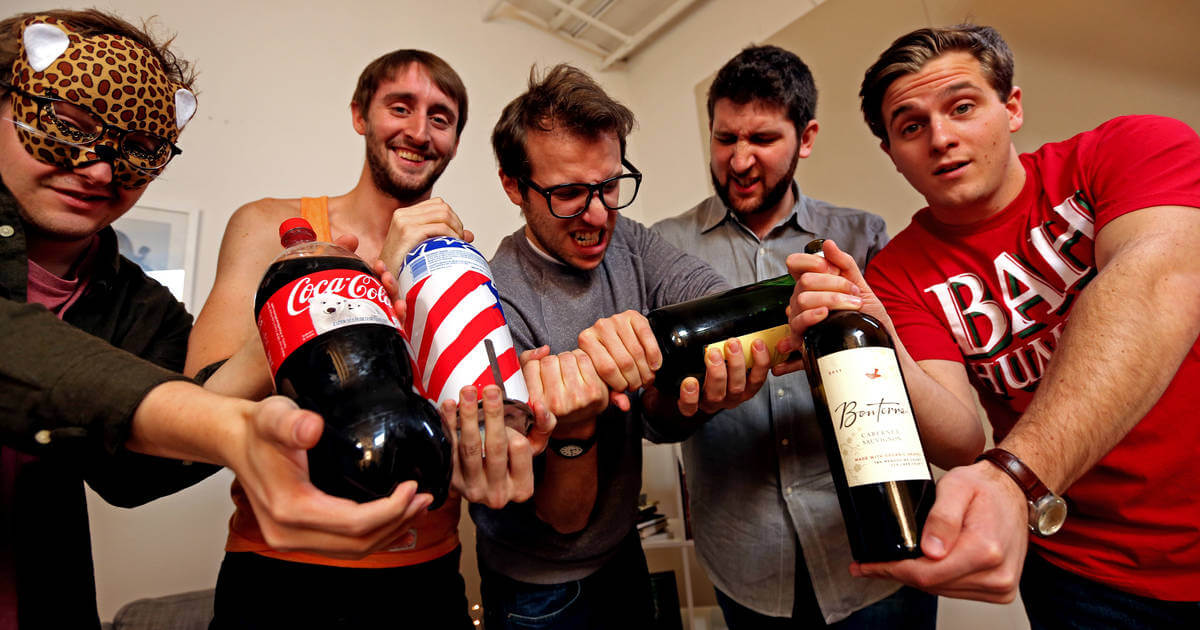
Internal goals and cultural attitudes toward alcohol are frequently overridden by the immediate cognitive pressure of external social expectations.
● Why: We wanted to know whether people's private intentions or their social environment drives actual behavior.
● Impact: Justified targeting the decision moment itself, rather than trying to shift attitudes upstream.
- What students personally believe about alcohol's role in college life is a strong predictor of how much they actually drink. Beliefs aren't just background noise, they directly shape behavior (Lui, 2019).
- These beliefs aren't uniform: expectations and attitudes toward alcohol vary meaningfully across gender and ethnic groups, meaning a single messaging approach won't land the same way for everyone (Lui, 2019).
- Positive expectancies about alcohol's effects, like believing it'll reduce stress or improve a social situation, reliably increase how much people drink. The reverse, general disapproval of drinking, reliably decreases it (Antin et al., 2013).
- Cultural background shapes drinking indirectly: it's not ethnicity itself that predicts alcohol use, but the beliefs and attitudes that tend to travel with it (Antin et al., 2013).
- Jones, D., Moodie, C., Purves, R., Fitzgerald, N., & Crockett, R. (2021). Alcohol packaging as a promotional tool: A focus group study with young adult drinkers in Scotland. European Journal of Public Health, 31(Supplement_3). https://doi.org/10.1093/eurpub/ckab164.346
- Jones, D., Moodie, C., Purves, R. I., Fitzgerald, N., & Crockett, R. (2022). The role of alcohol packaging as a health communications tool: An online cross‐sectional survey and experiment with young adult drinkers in the United Kingdom. Drug and Alcohol Review, 41(5), 1206–1215. https://doi.org/10.1111/dar.13469
- Morris, H., Larsen, J., Catterall, E., Moss, A. C., & Dombrowski, S. U. (2020). Peer pressure and alcohol consumption in adults living in the UK: A systematic qualitative review. BMC Public Health, 20(1). https://doi.org/10.1186/s12889-020-09060-2
- Perkins, H. W. (2002). Social norms and the prevention of alcohol misuse in collegiate contexts. Journal of Studies on Alcohol, Supplement, (s14), 164–172. https://doi.org/10.15288/jsas.2002.s14.164
- Cooper, M. L. (1994). Motivations for alcohol use among adolescents: Development and validation of a four-factor model. Psychological Assessment, 6(2), 117-128.
- Cooper, M. L., Frone, M. R., Russell, M., & Mudar, P. (1995). Drinking to regulate positive and negative emotions: A motivational model of alcohol use. Journal of Personality and Social Psychology, 69(5), 990-1005.
- Simon D’Aquino & Sarah Callinan (2024) Drinking to cope as a mediator of the relationship between stress and alcohol outcomes, Drugs: Education, Prevention and Policy, 31:5, 516-523.
- De Visser, Richard O., and Elizabeth J. McDonnell. “‘That’s OK. He’s a guy’: A mixed-methods study of gender double-standards for alcohol use.” Psychology & Health, vol. 27, no. 5, May 2012, pp. 618–639, https://doi.org/10.1080/08870446.2011.617444.
- Holmila, Marja, and Kirsimarja Raitasalo. “Gender differences in drinking: Why do they still exist?” Addiction, vol. 100, no. 12, 23 Nov. 2005, pp. 1763–1769, https://doi.org/10.1111/j.1360-0443.2005.01249.x.
- Uy, Philip J., et al. “Rethinking male drinking: Traditional masculine ideologies, gender-role conflict, and drinking motives.” Psychology of Men & Masculinity, vol. 15, no. 2, Apr. 2014, pp. 121–128, https://doi.org/10.1037/a0032239.
- Lui, P. P. (2019). College alcohol beliefs: Measurement invariance, mean differences, and correlations with alcohol use outcomes across sociodemographic groups. Journal of Counseling Psychology, 66(4), 487–495. https://doi.org/10.1037/cou0000338
- Antin, T. M. J., Lipperman-Kreda, S., Paschall, M. J., Marzell, M., & Battle, R. (2013). The Role of Drinking Beliefs to Explain Ethnic Variation in Drinking Practices Among U.S. College Students. Substance Use & Misuse, 49(1–2), 95–102. https://doi.org/10.3109/10826084.2013.821659
BEHAVIORAL ARCHETYPE
Who We Designed For
● Why: We chose behavioral archetypes over personas to design around shared motivations, not one fictional person's details.
● Impact: Kept our nudges focused on enhancement motives rather than coping-motivated due to the depth of adressing it.
Goals
- Seeking meaningful social engagement
- Finding a space to unwind and bond with others
Motivation
- Desire to feel part of a community
- Escaping routine stress and loneliness
Self-Image
- Aspire to feel confident and authentic without relying on alcohol
- Currently feeling self-doubt and fear judgment when considering alternatives
Mental Models
"And you're leaving your house, there's, a big world out there, but what seems like a finite number of options of what you can, like, realistically get your friends together to go."
"Drinking makes socializing easier."
Coping
- Uses alcohol as a way to manage social anxiety or stress.
Norm Signficance
- Struggle with existing norms where drinking is associated with bonding
- Questioning if alcohol is necessary for connection
JOURNEY MAP ♦︎
Mapping The Moment It Could Change
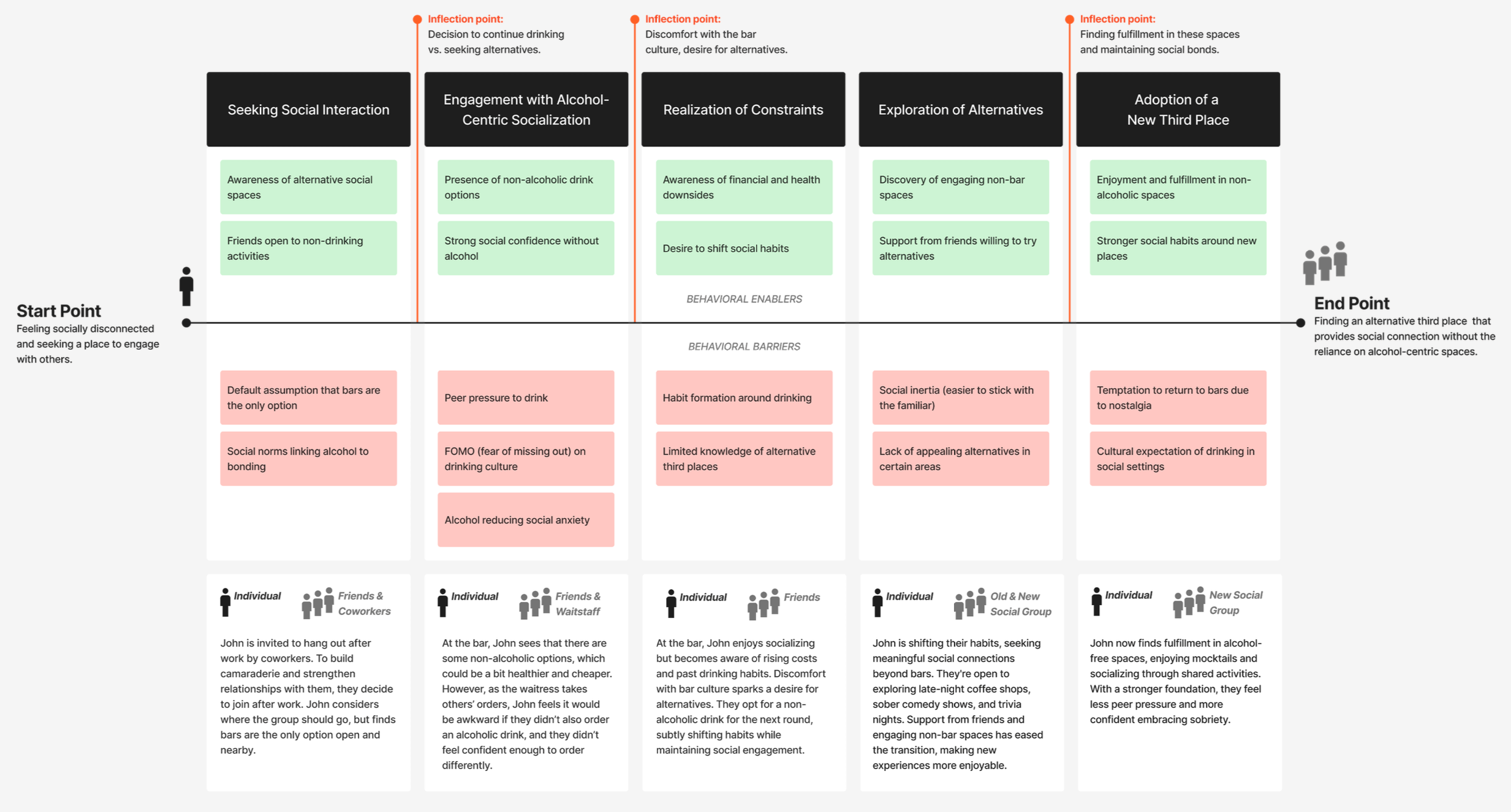
● Why: We mapped the micro-moments of a night out to find exactly when a nudge could realistically change a decision.
● Impact: Identified "Seeking Social Interaction" and "Exploring Alternatives" as our two highest-leverage moments.
Legend
● Inflection Point: opportunity to "nudge" with solution
● Shows the positives of the activity.
● Shows the negatives of the activity.
2 Key Moments For Our Solution
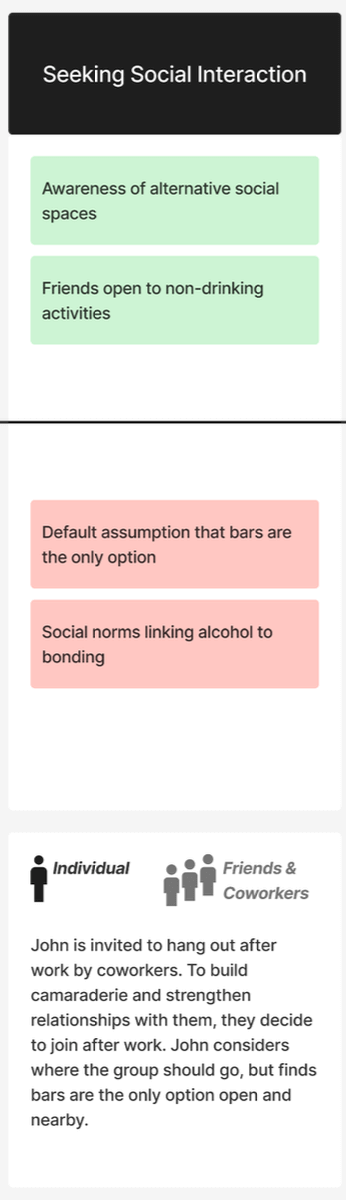
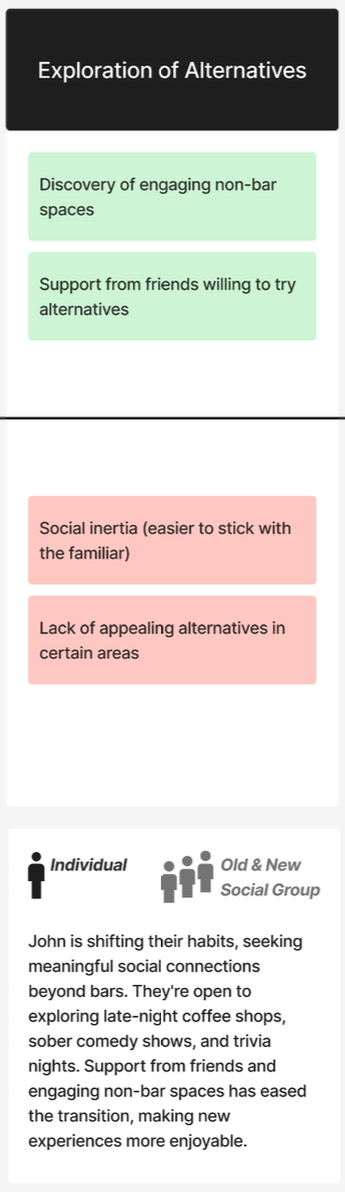
We determined that the 2 key moments for our solution to make the greatest impact were the "Seeking Social Interaction" and "Exploration Of Alternatives" moment when deciding to go to a "third place".
Seeking Social Interaction
Opportunity Areas
- People want to connect. Alternatives like sober venues or shared activities (axe throwing, billiards) can fulfill that need.
Decision Levers
- Success depends on making these spaces convenient, socially inviting, and clearly valuable to strengthen relationships.
Exploring Alternatives
Opportunity Areas
- When considering options beyond bars, late-night cafés and sober events help shift routines with like minded people.
Decision Levers
- Offering fun, engaging choices makes the transition feel exciting, not limiting.
PARTICIPANTS + INTERVIEW FORMAT
Talking To Drinkers & Non-Drinkers Alike
Who We Talked To
Total Participants
10 (5 drinkers, 5 non-drinkers)
**Eventhough our project was for drinkers we believed hearing stories from non-drinkers would be valuable for our solution.
Age Range
23-28 years
Gender Distribution
6 Male, 4 Female
Occupations & Fields
Students, business professionals, non-profit, and tech workers.
Why This Sample?
Ensures a diverse range of perspectives Covers different life stages: students vs. working professionals Balances personal drinking habits for unbiased insights
How We Listened
Format
10 total = 5 drinkers + 5 non-drinkers
4 females, 6 males
Recieved Consent
Screen & audio recording
Interview Question Types
Open ended questions
Card-Sorting Activity
Our card-sorting activity is about understanding the participants' perception of different types of people alcoholic drinks per week.
Post Card-Sorting Activity Questions
Perceptions of Others Messaging & Education Stress & Coping
INTERVIEW FINDINGS
What They Told Us
Theme 1: Prioritization Of Health For Non-Drinkers
Personal Health
Reduce or elimate anxiety, gastrointestinal issues, allergic reactions
"I noticed that I would have like more anxiety when I was drinking, and like the anxiety is what caused the GI issues."
"I have seen that my body doesn't go well with alcohol."
Social Interactions from Influences
Observed: Family problems stemming from consumption & friends/strangers acting unsafe when intoxicated
"A lot of like the problems that have happened in our family, like arguments and stuff are always worse. They either happen because people have the courage to fight with each other because they're drunk, [...] and people say worse things when they're drinking."
"People lose control. Sometimes they don't know what their limits are."
Educational Programs
Drug abuse programs in college informed users about the effects, which deinfluenced them
"We also learned about the negative effects of alcohol. Alcohol can literally kill you. And people around you might not even notice it."
Theme 2: Alcohol Culture Fills the Social Gap 
A Way To Open Up
Drinking showed signs of improved social life and friendships by reducing anxiety with everyone.
"Yeah, I think, you know, our house parties, especially because everyone's drinking and also, I think sometimes the alcohol actually helped me to open up a little bit." "You have people to talk around with. You can feel a bit more light hearted. It helps with the social anxiety."
Social Life = Physical Health
Participants with likeminded friends push each other for healthy habits.
"I think having a community around me would be helpful because you need people you can talk to about the cravings you're having, and it just helps you be distracted."
"Yeah, I did Dry January. I was like, okay, l guess / can do it. It's kind of a cultural trend, cultural challenge, you know? Some friends were doing it, so we supported each other and cut back on alcohol."
Bars, The Go To Third Place
Bars provide a comfortable environment to simply "hang out" with friends.
"And you're leaving your house, there's, a big world out there, but what seems like a finite number of options of what you can, like, realistically get your friends together to go."
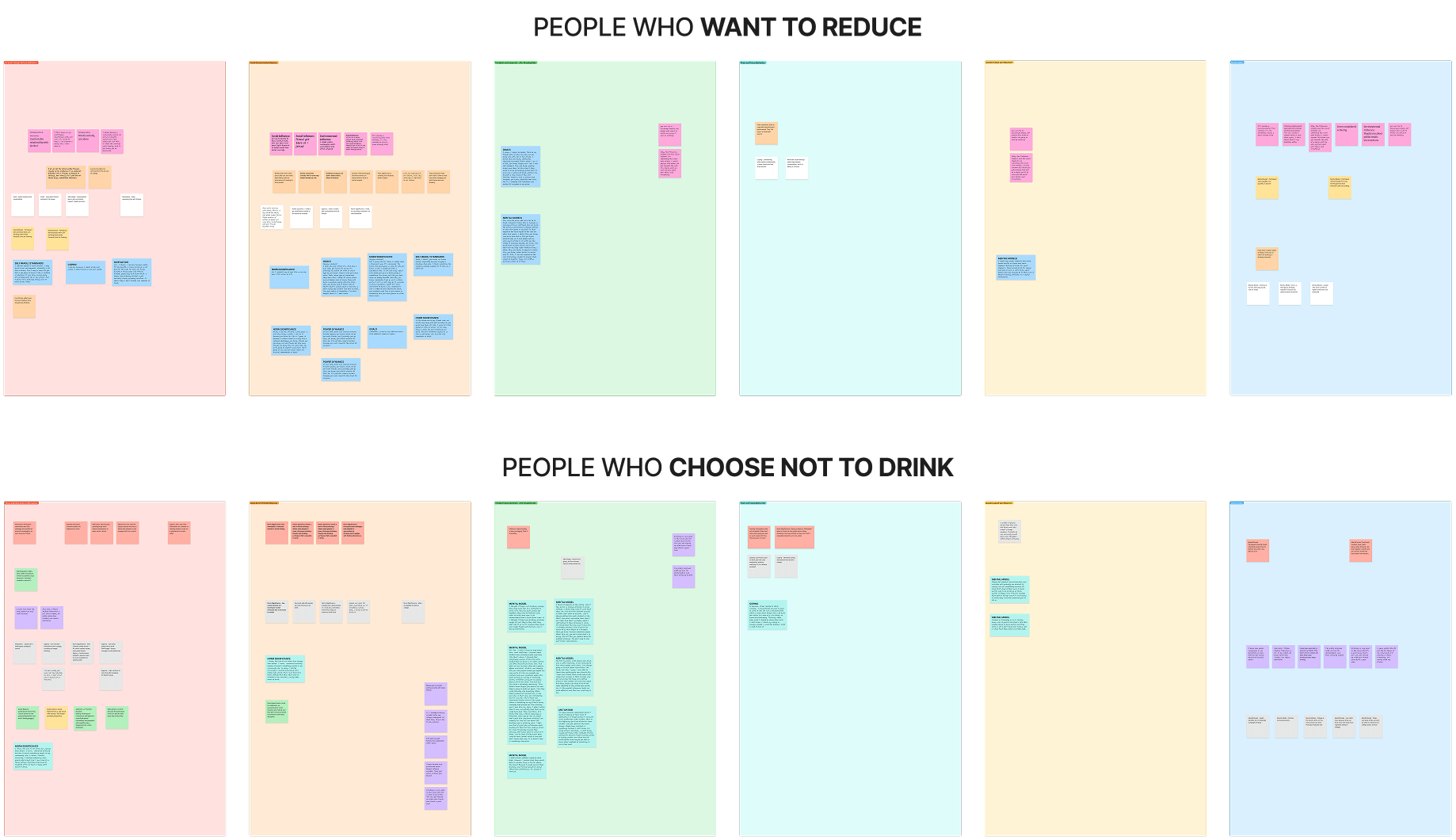
Affinity Diagram Details:
The affinity diagram was created for participants who WANT TO REDUCE and CHOOSE NOT TO DRINK.
The affinity diagram sections are:
- Personal Drinking Habit and Motivations
- Social & Environmental Influences
- Stress and Coping Mechanism
- Perceptions and Awareness - After Revealing Data
- Questions about Card Placement
- Mental Models
MESSAGING SERVICE VS APP SERVICE ✘
Why We Didn't Build an App
● Why: We compared a full app against a lightweight messaging service to avoid overbuilding for a timing problem.
● Impact: Confirmed messaging as the leaner MVP, directly shaping our Feasibility reasoning
Messaging Service
Pros ❤︎
- Simple setup (only needs phone number).
- Works with existing SMS apps.
- Minimal storage (uses default system).
- Familiar interface, no learning curve.
- Low-cost, flexible, and lightweight solution.
Cons ✖
- Easy to overlook as regular messages.
- Limited customization and branding.
- Harder to track engagement or analytics.
App Service
Pros ❤︎
- Dedicated app with distinct notifications.
- More control over design, branding, and features.
- Can track usage and gather user data.
- Supports richer content (media, interactive features).
Cons ✖
- Requires development resources.
- Takes storage space on device.
- Higher barrier to entry (download needed).
- Steeper learning curve for some users.
- May exclude users with limited data plans.
MARKET RESEARCH
Proof This Model Already Works
We have turned a possible competitor, The Nudge, into our solution.
About The Nudge
The Nudge is a service that messages users of any local place near them. They have proven that this is a successful model given its availability in 10 large cities with over 1 million users. Leveraging this idea to target people seeking alternative third places to replace bars and partnering with influencers with similar content and marketing would be an easy lift.
How We Would Use The Nudge
We would like to use The Nudge platform to suggest third places that don't primarily around alcohol consumption.
It's extremely simple feasible system, text-based subscription service, is low-cost and accessible to everyone with a basic cell phone plan.
DESIGN CHANGES ⏏︎
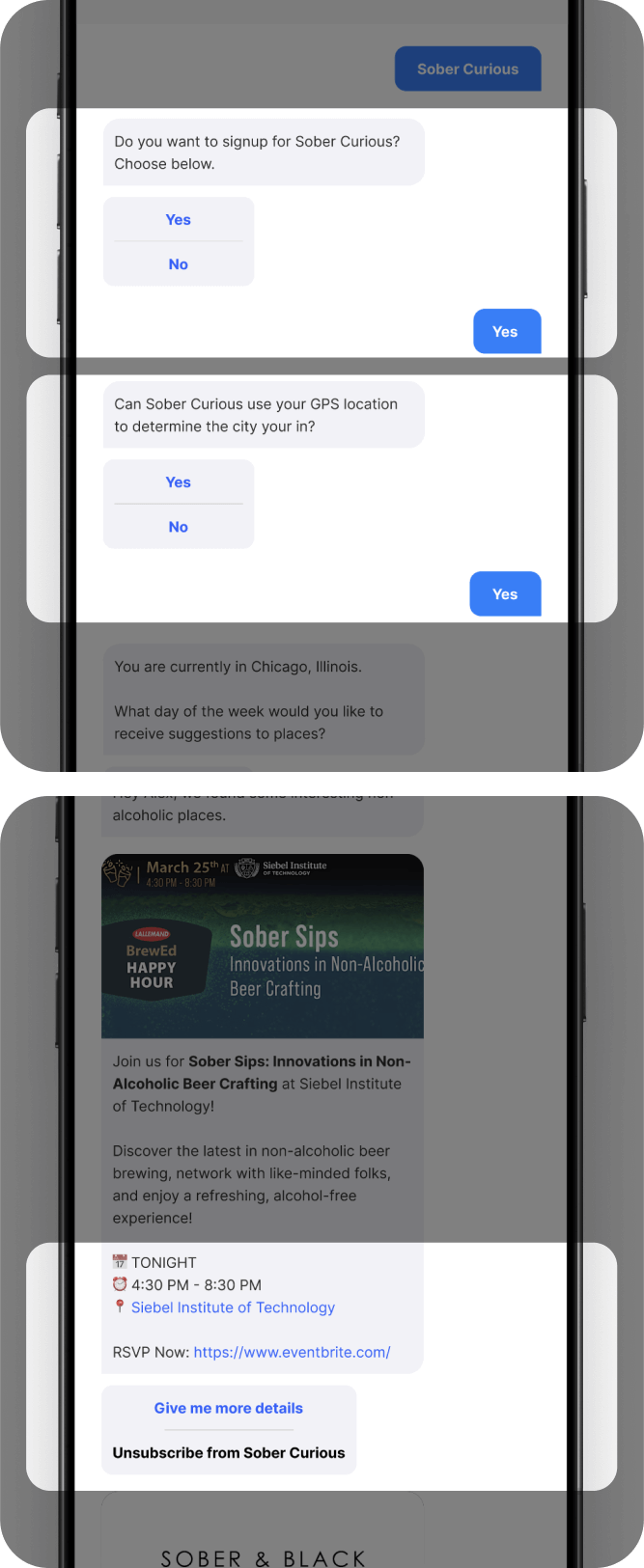
From Typing To Tapping
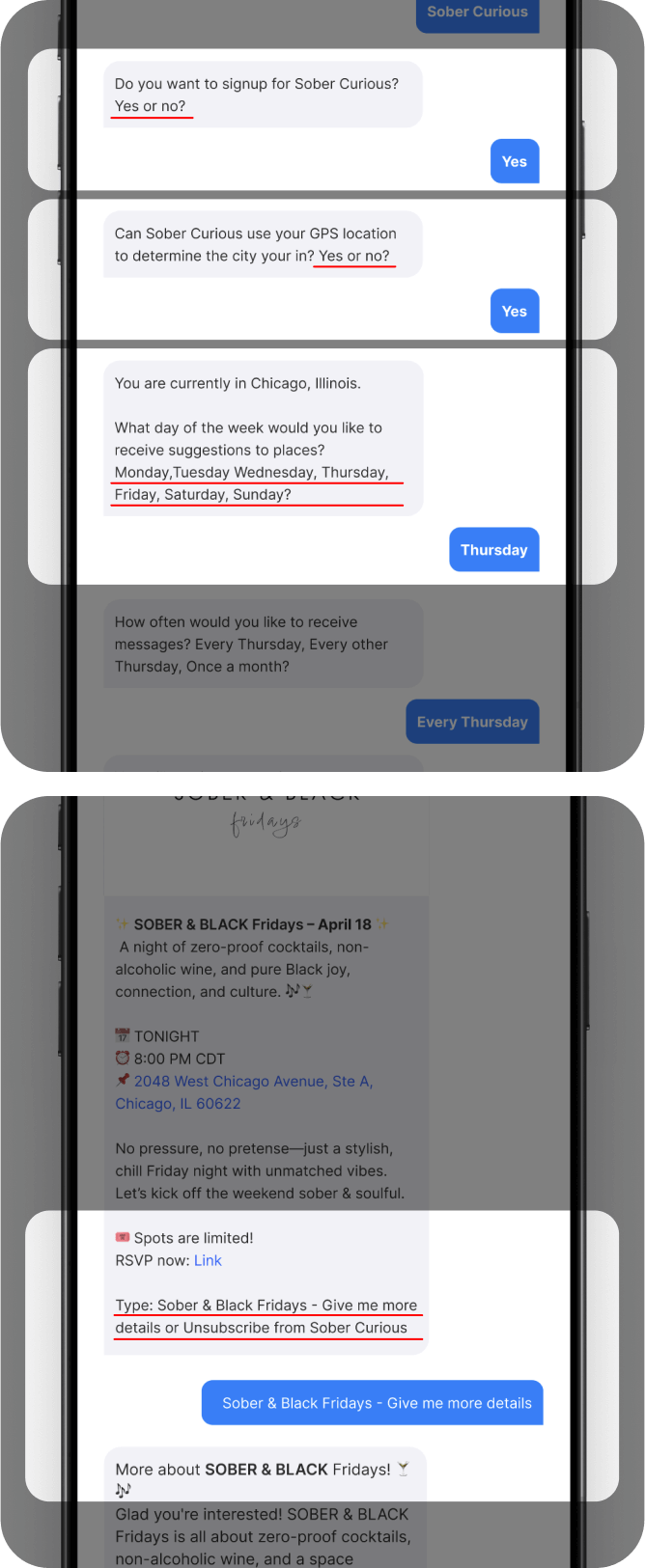
Chatting With Sober Curious
V1 - Dependant On Typed Messages
- Many user's were annoyed that they would need to type their responses.
FINAL
- We changed the user interaction from typing answers to clicking on options.
REFLECTION ⬅
Looking Back
What We Did Well
Grounded in Behavioral Science
We used peer-reviewed research and interviews, including both drinkers and non-drinkers, to uncover real motivations behind drinking habits rather than relying on assumptions.
Timely, Low-Friction Nudges
Our SMS-based intervention was low-friction and context-aware, designed to reach people at the key decision moments our journey map identified.
Archetype-Driven Design
Designing around behavioral archetypes, rather than fixed personas, kept us focused on shared motivations instead of getting stuck on demographic details.
What We Can Do Later
Prototype & Test
Future iterations should include usability testing to validate message tone and timing.
Expand Demographics
Including older users or parents could reveal new insights.
Functional MVP
Start developing a functional MVP.
What We Would Do Differently
Refine Messaging
Clickable options helped, but future versions should test tone and emotional resonance.
Balance Research & Design
We’d add more visual deliverables—wireframes, mockups—to showcase design execution.
Accessibility
We’d explore how to make the experience more inclusive for users with impairments.